
impersona
AI character dialogue platform that simulates personal style and delivers personalized text interactions
Monthly Visits
348
Avg. Session Duration
1 min
Category Rank
N/A
Bounce Rate
0.4%
What is impersona?
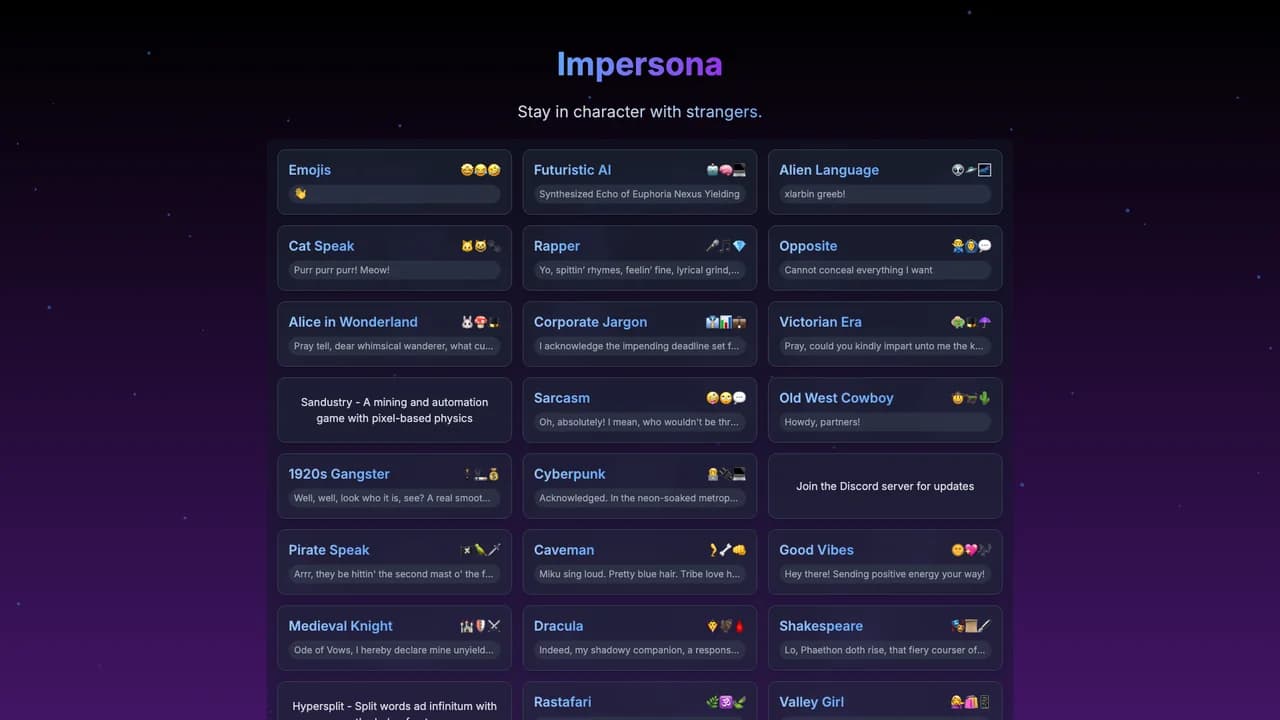
Impersona is an AI-powered tool that enables users to engage in authentic conversations with AI simulations of any individual, such as authors, bloggers, or public figures. The platform creates dynamic chat experiences by analyzing texts related to the person, accurately replicating their style, knowledge, and viewpoints. Users can explore ideas, validate concepts, or interact in a highly personalized manner with these virtual representations.
Key Features of impersona?
Alternatives to impersona

solabai
Solab.ai hosts Socratic Lab, a dynamic platform where users engage in knowledge exchange through questions, answers, and discussions, supported by an AI assistant named Socrates. The platform integrates advanced language models to deliver context-aware and accurate responses, while fostering connections among users with shared interests. It combines human collaboration with AI insights to create an environment that encourages in-depth exploration and collective learning.

laion
LAION (Large-scale Artificial Intelligence Open Network) is a German non-profit organization dedicated to democratizing AI research by freely providing large-scale open datasets, models, and tools. It focuses on advancing public education and promoting environmentally sustainable AI development by encouraging the reuse of existing datasets and models. LAION is renowned for its extensive image-text datasets such as LAION-400M and LAION-5B, which have been widely used to train prominent AI models. The organization also supports community collaboration and open-source contributions to drive progress in global machine learning research.

hello-history
Hello History leverages advanced AI technology, including GPT-4, to simulate authentic conversations with over 400 historical figures. Users can ask questions, engage in debates, and explore diverse topics, with all interactions personalized to individual interests. Designed with an educational focus, the platform empowers history learning by bringing historical figures to life, fostering critical thinking and deeper understanding. It also provides teachers with rich multimedia resources and curriculum-aligned tools, making it a versatile solution for both classroom instruction and independent learning.

zai
Zhipu is a cutting-edge artificial intelligence platform that delivers powerful open-source large language models, including the GLM-4, GLM-Z1, and GLM-Z1-Rumination series. The platform focuses on advanced reasoning, code generation, and in-depth research capabilities through its proprietary models, which range from 9B to 32B parameters. Users can interact with these models via the z.ai chat interface, experiencing high-performance inference speeds and sophisticated problem-solving abilities. By releasing its models under the MIT license, the company has made significant contributions to the open-source AI community, enabling developers to freely use, modify, and commercialize the technology.

wikiwand
Wikiwand is a proprietary interface designed to enhance the Wikipedia reading experience by offering a cleaner layout, optimized typography, and seamless navigation. Since its inception in 2013, it has integrated AI technologies such as GPT-3 to deliver AI-generated article summaries, text-to-speech functionality, and a question-answering assistant, helping users quickly grasp key information. Available as a browser extension and web platform, it supports multilingual access, interactive timelines, and article quality ratings, making Wikipedia content more accessible and user-friendly while maintaining neutrality and transparency.

zhihu-zhida
Zhihu ZhiDa is an intelligent search platform launched by Zhihu that leverages the Zhihai Graph large language model to deliver direct and accurate answers to user queries. The platform integrates high-quality content from Zhihu's creator community with external web sources to provide comprehensive responses. Users can access both concise and in-depth answer modes, with transparent source attribution indicating which contributors and references informed each response. The platform operates through a four-stage process: understanding the query, retrieving information, generating the answer, and finalizing the response with appropriate citations.


