
deepwiki
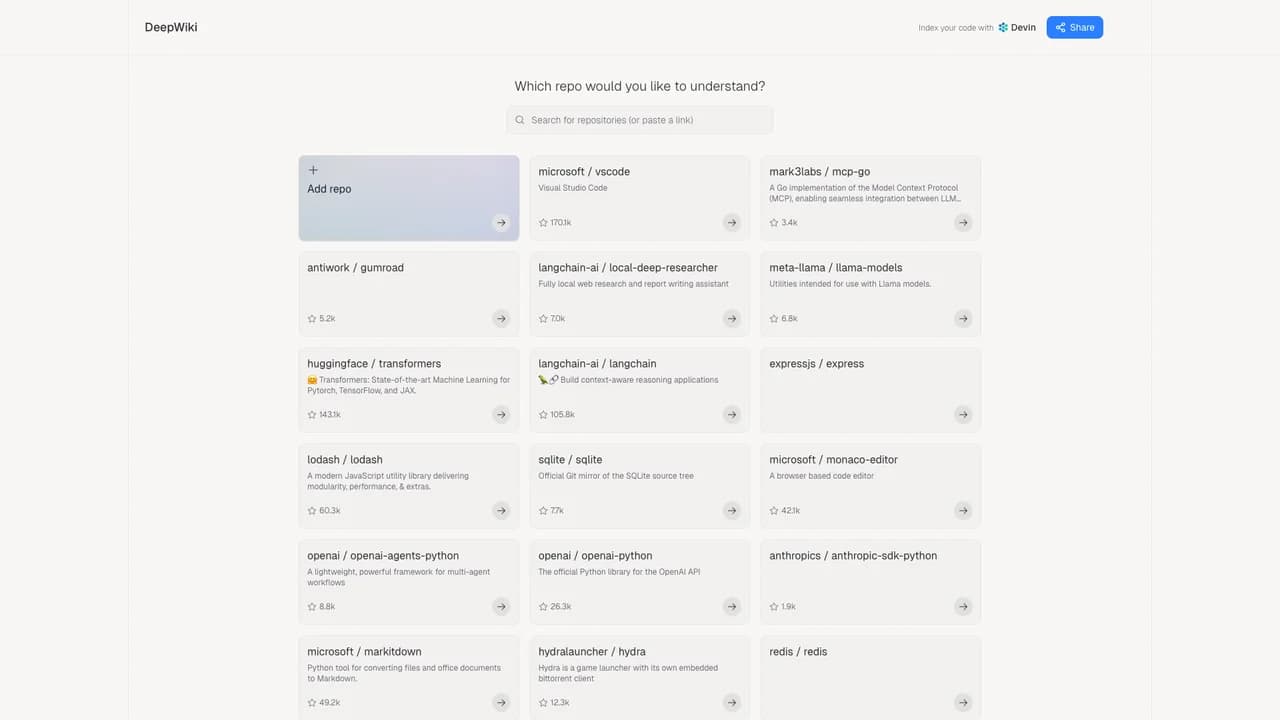
A codebase documentation generator that automatically creates structured documentation and supports interactive querying.
Monthly Visits
1.2M
Avg. Session Duration
4 min
Category Rank
N/A
Bounce Rate
0.5%
What is deepwiki?
DeepWiki automatically analyzes the entire codebase, README files, and configuration details of GitHub repositories to generate comprehensive, Wikipedia-style documentation. It organizes information into clear modules, technology stacks, and file structures, supplemented by interactive architecture diagrams. Users can interact with the documentation through a conversational assistant that answers specific questions about the codebase. Additionally, DeepWiki offers a deep research mode that provides advanced insights comparable to those of a senior engineer. Public repositories are freely accessible, while private repositories require authentication.
Key Features of deepwiki?
Alternatives to deepwiki

chonkie
Chonkie is an open-source Python library designed to efficiently split large, complex documents into meaningful and independent chunks for Retrieval-Augmented Generation workflows. It supports multiple chunking strategies, including token-based, word-based, sentence-based, and semantic chunking, allowing developers to customize text segmentation according to specific NLP and machine learning requirements. Lightweight and fast to install, Chonkie helps accelerate processing and optimize context management for large language models, enabling users to overcome token limitations and improve retrieval accuracy.

notebooklm
NotebookLM, developed by Google Labs and powered by Google Gemini AI, is an advanced AI-first notebook designed to revolutionize how users interact with documents. Unlike traditional note-taking apps, it creates a personalized AI agent based on your uploaded content—such as PDFs, Google Docs, web pages, and slides—enabling precise summarization, explanation, and cross-document analysis tailored exactly to your knowledge base. It also features podcast-style audio summaries, making information consumption more flexible and engaging.

dataworld
data.world is an innovative cloud-based data catalog solution that helps organizations connect, understand, and trust their data assets. Built on a knowledge graph architecture, it provides comprehensive metadata management, automated data enrichment, and AI-powered search capabilities. The platform enables seamless data discovery, governance, and collaboration, empowering diverse teams to efficiently and securely access actionable insights.

contextual-ai
Contextual AI provides a comprehensive platform designed to build, deploy, and scale RAG applications tailored to complex enterprise needs. By optimizing retrieval and generation as a unified system, it addresses critical challenges such as hallucinations, outdated data, and data privacy. The platform supports multiple data types, enterprise-grade security, and flexible deployment options, enabling organizations to transform vast and complex documents into actionable insights with high precision and control.

infranodus
InfraNodus is a web-based AI tool that transforms text into network graphs, representing words and concepts as nodes connected by co-occurrence relationships. This visualization helps users quickly grasp main topics, identify key elements, and uncover gaps in discourse structures. By integrating network analysis, natural language processing, and AI, InfraNodus supports idea generation, complex text summarization, qualitative analysis, as well as SEO and market research. Its unique approach fosters cognitive diversity and deeper insights by highlighting underexplored connections and peripheral ideas within a text or dataset.

castordoc
CastorDoc is a next-generation data catalog designed to democratize data access and empower organizational collective intelligence. It seamlessly integrates with existing data ecosystems, automatically ingests metadata, and delivers AI-powered data discovery alongside collaborative documentation management. With an intuitive interface and AI assistant, CastorDoc enables users of all backgrounds to easily find, understand, and trust data, facilitating collaboration among data, governance, and business teams. The platform supports compliance, data quality, and privacy protection, while reducing the burden on data teams through self-service analytics and natural language queries.


